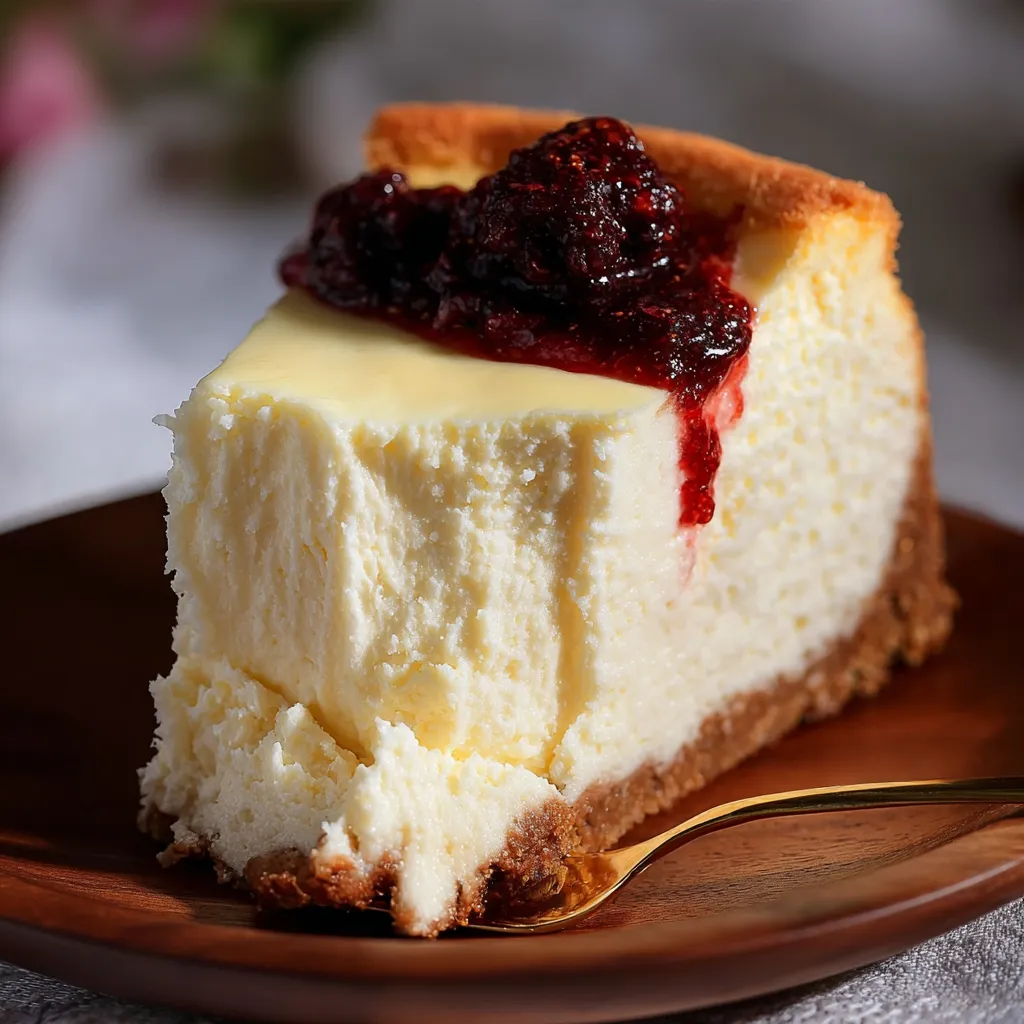
Description
Okay, so this isn’t just “a” cheesecake recipe. This is THE cheesecake recipe—the one that makes people stop mid-bite and ask what sorcery you used, the one that gets requested for every birthday and holiday, the one that spoils you for life because regular cheesecake will never hit the same again. We’re talking tall, dense, impossibly creamy New York-style cheesecake with a buttery graham cracker crust and a texture so smooth it’s almost indecent. No cracks, no weird textures, no disappointment—just pure, unadulterated cheesecake perfection that’s somehow both light and decadent at the same time. I made this for Thanksgiving once and my aunt literally cried. Another time I brought it to a potluck and three different people offered to pay me to make them one. This cheesecake has LIFE-CHANGING CAPABILITIES.
Ingredients
For the Graham Cracker Crust:
- 2 1/2 cups graham cracker crumbs (about 18–20 graham crackers)
- 1/3 cup granulated sugar
- 3/4 cup (1 1/2 sticks) unsalted butter, melted
- Pinch of salt
For the Cheesecake Filling:
- 32 oz (four 8-oz packages) cream cheese, softened to room temp (THIS IS NON-NEGOTIABLE)
- 1 1/4 cups granulated sugar
- 1/4 cup all-purpose flour (secret weapon for preventing cracks)
- 1 cup sour cream, room temperature
- 4 large eggs, room temperature
- 2 large egg yolks, room temperature (for extra richness and creaminess)
- 2 tsp vanilla extract
- 1 tsp lemon zest (optional but adds brightness)
- Pinch of salt
Optional Toppings:
- Fresh berries
- Fruit compote
- Chocolate ganache
- Caramel sauce
- Whipped cream
- Or keep it naked and simple
Equipment:
- 9-inch or 10-inch springform pan (MUST be springform)
- Food processor or zip-top bag for crushing crackers
- Hand mixer or stand mixer
- Rubber spatula
- Roasting pan (for water bath—optional but recommended)
- Aluminum foil
- Parchment paper
Instructions
Step 1: Prep Your Pan
Preheat oven to 325°F (160°C).
Wrap the outside and bottom of a 9-inch springform pan with TWO layers of heavy-duty aluminum foil. This prevents water from seeping in if using a water bath.
Line the bottom of the pan with parchment paper (optional but makes removal easier).
Lightly grease the sides of the pan with butter or cooking spray.
Set aside while you make the crust.
Step 2: Make the Graham Cracker Crust
In a food processor, pulse graham crackers until they’re fine crumbs. Or put them in a zip-top bag and crush with a rolling pin until therapeutic stress relief is achieved.
In a medium bowl, mix graham cracker crumbs, sugar, melted butter, and salt until the mixture looks like wet sand and holds together when squeezed.
Press the mixture firmly and evenly into the bottom of the springform pan and about 2 inches up the sides. Really pack it down—use the bottom of a measuring cup or glass.
Make sure the crust is even throughout, especially in the corners where the bottom meets the sides.
Bake the crust for 10 minutes until lightly golden and fragrant.
Remove and let cool while you make the filling. Keep the oven on.
Step 3: Make the Cheesecake Filling (The Most Important Part)
Make ABSOLUTELY CERTAIN your cream cheese is at room temperature. I’m talking soft enough to easily spread but not melted or oily. This cannot be emphasized enough. Cold cream cheese = LUMPY DISASTER.
In a large bowl (or stand mixer with paddle attachment), beat cream cheese on medium speed for 3-4 minutes until completely smooth, fluffy, and no lumps remain. Scrape down the bowl frequently.
Add sugar and flour. Beat on medium speed for 2 minutes until well incorporated and fluffy.
Add sour cream, vanilla extract, lemon zest (if using), and salt. Beat on low-medium speed until just combined and smooth.
Add eggs and egg yolks ONE AT A TIME, mixing on LOW SPEED after each addition. Mix ONLY until just incorporated—about 10-15 seconds per egg. DO NOT OVERMIX after adding eggs. Overmixing incorporates too much air which causes cracks and texture issues.
Use a rubber spatula to scrape down the bowl and fold gently to ensure everything is incorporated.
The batter should be smooth, thick, creamy, and pale yellow. No lumps, no air bubbles.
Step 4: Pour and Prepare for Baking
Pour the cheesecake batter over the cooled crust in the prepared pan.
Smooth the top with a spatula.
Tap the pan firmly on the counter 10-15 times to release air bubbles. You’ll see them rise to the surface—this is good.
Water Bath Method (Recommended for Beginners):
Place the wrapped springform pan in a large roasting pan. Fill the roasting pan with hot water until it comes about halfway up the sides of the springform pan. This creates a gentle, humid cooking environment that prevents cracks.
No Water Bath Method:
Place a large baking pan filled with hot water on the bottom rack of the oven (below where the cheesecake will bake). This creates steam without the risk of water leaking into your pan.
Step 5: Bake Low and Slow
Bake at 325°F for 1 hour and 15 minutes to 1 hour and 30 minutes.
The cheesecake is done when the edges are set and puffed slightly, but the center 3-4 inches still jiggles like jello when you gently shake the pan.
It should NOT look liquid, but it should definitely jiggle. This is what you want. If the center looks solid, you’ve overbaked it.
The internal temperature should be about 150-155°F in the very center when you insert a thermometer.
DO NOT open the oven door during the first hour of baking. Drafts cause cracks.
Step 6: Cool Gradually (CRUCIAL STEP)
Turn off the oven and crack the door open about 4 inches.
Let the cheesecake cool in the oven with the door ajar for 1 HOUR. This gradual temperature change prevents cracks from thermal shock.
After 1 hour in the oven, remove the cheesecake and let it cool on the counter to room temperature—about 2 hours.
Don’t rush this. Sudden temperature changes = cracks.
Once at room temperature, run a thin knife around the edge of the pan to loosen the cheesecake from the sides. This prevents it from cracking as it contracts during chilling.
Step 7: Chill Overnight
Cover the cooled cheesecake (still in the pan) with plastic wrap. Don’t let the plastic touch the surface—tent it over or place parchment on top first.
Refrigerate for AT LEAST 8 hours, but preferably 12-24 hours.
Cheesecake NEEDS this time to fully set and for flavors to develop. This is not optional. Be patient.
The texture and flavor improve dramatically after 24 hours.
Step 8: Unmold and Serve
When ready to serve, carefully remove the sides of the springform pan.
Use a large offset spatula to slide the cheesecake off the base onto a serving plate (or just serve it on the base).
Let sit at cool room temperature for 20-30 minutes before slicing for best texture and flavor.
Use a large, sharp knife to slice. Wipe the knife clean and run it under hot water between each cut for perfect, clean slices.
Top with your chosen toppings or serve plain in all its glory.
Watch as people take their first bite and their eyes roll back in pleasure.
Notes
This is perfect plain, but here are some classic topping ideas:
- Fresh strawberries, blueberries, or mixed berries
- Strawberry or raspberry sauce
- Chocolate ganache drizzle
- Salted caramel sauce
- Lemon curd
- Cherry pie filling (classic)
- Fresh whipped cream
- Dulce de leche
- Crushed Oreos or cookies
- Toasted nuts
- Prep Time: 30 minutes
- Cook Time: 1 hour 30 minutes
Nutrition
- Calories: ~450 kcal
- Sugar: ~28g
- Sodium: ~310mg
- Fat: ~30g
- Carbohydrates: ~38g
- Protein: ~8g